AI Visibility Tracking Service
See how AI answers mention and cite your brand over time, by engine, model and date.
GeoAeoLab's AI visibility tracking service re-runs an agreed set of prompts on a schedule across the AI engines we agree with you, such as ChatGPT, Perplexity, Gemini and Google AI Overviews, and reports how often your brand is named and cited. Every number comes with its engine, model and date, and with the spread between runs. We agree the prompt set with you, write down the conditions, and walk through each report together.
What we track
LLM visibility monitoring here means five things, logged on every run. Mentions and citations are counted separately, because an answer can name your brand without linking to you, and the other way around. For how this looks in ChatGPT, see ChatGPT brand citation mismatch.
Mentions
Whether your brand is named in the answer, run by run.
Citations
Whether the answer links to your site, and to which URL.
Competitors named
Which of the competitors you agreed with us are named in the same answers.
Sources cited
Which outside sources are cited across your prompt set, and how that list changes from one period to the next. We record what is cited; we don't claim to know why an engine picked a source.
What answers say about you
A short note per answer. We flag inaccurate facts and where to correct them at the source, such as your own site or profiles.
We run the engines we agree on at the start: ChatGPT, Perplexity, Gemini, and Google AI Overviews / AI Mode (Google's guidance on AI features).
See monitoring sample
Below is the structure of one period's report. It is not data: there are no figures here, and every value in your report comes from your own runs. Each row in your report carries the engine, the model (when the engine shows it), the dates of the period and the version of the prompt set.
The run-by-run log is the same as in the audit report, so we don't repeat its columns here: see the same run-level log as in the audit report.
We agree the report format and schedule with you before the first run.
#sample-period-summary
Period summary
One row per engine per period. This is the table you read first.
Column
What it shows
Period
Start and end dates of the tracking period
Engine
ChatGPT, Perplexity, Gemini, Google AI Overviews / AI Mode (whichever are in scope)
Model
Model version(s) seen in the period, where the engine shows it; otherwise "not shown"
Prompt set
The version of the agreed prompt set used in the period
Runs
How many runs the period's numbers are based on
Mention rate
Share of runs in which your brand is named
Citation rate
Share of runs in which the answer links to your page
AI share of voice
Your mentions as a share of all tracked brands' mentions
Change vs previous period
Difference from the previous comparable period, or "not comparable" if conditions changed
Spread between runs
How much results for the same prompts varied within the period
#sample-competitors
Competitors
One row per brand, engine and period.
Column
What it shows
Brand
Your brand or one of the competitors you agreed with us
Engine
The engine the row refers to
Period
Start and end dates of the period
Mentions
How often the brand is named in answers to the prompt set
AI share of voice
The brand's mentions as a share of all tracked brands' mentions
Change vs previous period
Difference from the previous comparable period, or "not comparable"
Only the competitors you agreed with us appear here. This is not a ranking of your market.
#sample-prompt-changes
Prompts that changed
One row per prompt per engine. It helps you tell a real change from the usual spread between runs.
Column
What it shows
Prompt
The prompt, as written in the agreed set
Engine
The engine the row refers to
Previous period
What the prompt returned in the previous period
This period
What it returned in this period
Within the usual spread?
Whether the difference falls inside the variation we see between runs of the same prompt
Note
Anything the reader needs to interpret the row
#sample-sources
Cited sources over time
One row per source. Several cited URLs can share one origin: see AI citation source lineage.
Column
What it shows
Source (domain)
The domain that was cited
Source type
Your site, competitor, publication, directory, review site, documentation, or discussion forum such as Reddit
Cited for (prompts and engines)
Which prompts and engines cited it
First seen
The first period in which it was cited
Last seen
The most recent period in which it was cited
Mentions you?
Whether the cited source names your brand
#sample-change-log
Change log
One row per event.
Column
What it shows
Date
When the change happened or was noticed
What changed
A model version shown by the engine, an engine feature, a new prompt set version, or a change on your site (by you or by us)
Effect on comparability
Whether periods before and after the change can still be compared
Answers change even when nothing changes on your site. The log is how a report shows that.
#sample-next-steps
Notes and next steps
One row per observation.
Column
What it shows
Observation
What we noticed in the period
Evidence (prompts, engines, dates)
The runs the observation rests on
Suggested action
What could be done about it
Who (us or you)
Who would do it
Priority
How urgent we think it is
Tracking vs a one-off audit
An AI visibility audit is a snapshot of one window of dates, plus checks of your brand data, technical access and sources, and it ends in priorities. Our AI visibility tracking service re-runs the same prompts on a schedule, so you get the change over time, a comparison of periods measured under the same conditions, and a change log. We usually start with an audit, because its prompt set can become version 1 of the tracking set.
How tracking runs
Five steps, in this order.
- 1
Agree the prompt set
We take it from your audit, and record it as version 1.
- 2
Set the schedule
We confirm the engines, the market and language, and how often the prompts run.
- 3
Run and log
Each prompt runs several times in each engine. Every run is logged with its engine, model (if shown) and date.
- 4
Report each period
You get a report in the structure shown in
the monitoring sample - 5
Review together
We walk you through the report: what changed, and what stayed within the spread. If we change the prompt set, that is a new version, and the change log notes what it does to comparability.
We agree the schedule with you before the first run.
What tracking shows, and what it doesn't promise
Tracking shows what is happening in AI answers; it does not make it happen. Answers change between runs, models and dates.
We do
- Re-run the agreed prompts on a schedule, and log the engine, model and date of every run.
- Show mentions, citations and AI share of voice per engine and period.
- Show how much results differ between runs.
- Mark a period as not comparable when something changed, such as a new model or a new version of the prompt set.
- Flag inaccurate facts and where to correct them at the source.
We don't promise
- That your mentions, citations or AI share of voice will grow.
- A place in any AI answer or in Google.
- Any outcome from work on your visibility. We improve your chances, measure and report.
- That a change in a single period is a trend.
- That our runs match what every user sees. An answer depends on the run, the model, the date and the user's context.
We don't use
Hidden paid mentions, fake reviews or "independent" articles, fake accounts, spam in discussions, hidden text or prompt injection aimed at models, and mass-produced content made to game search or AI answers. Google's spam policies cover hidden text and scaled content abuse in Search.
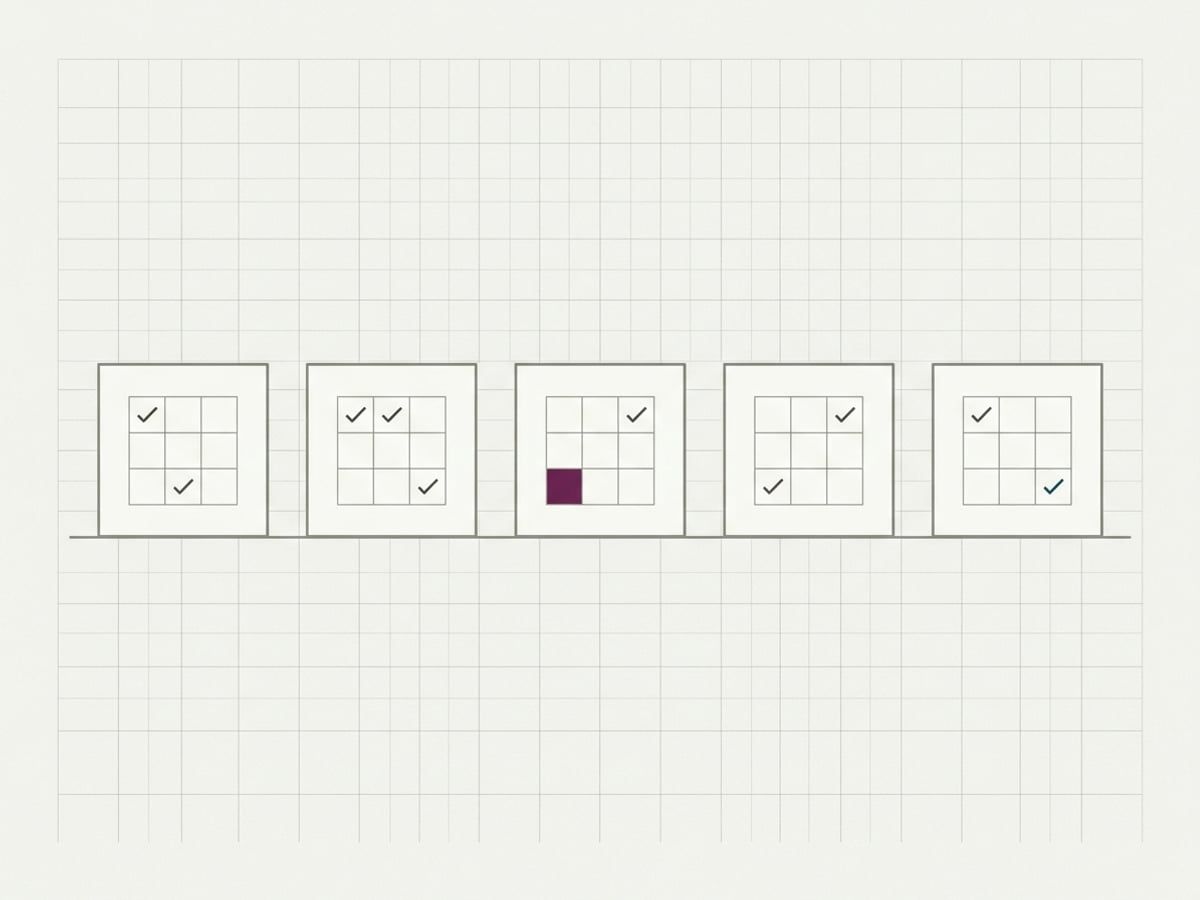
Tally · same prompt, 8 runs
[engine] · [model] · [date range]Answers change from run to run, so we count repeats instead of trusting one screenshot.
How we keep periods comparable
A trend is visible only if two periods were measured the same way. Here is what we hold fixed.
- 1
A versioned prompt set
The prompt set has a version number, and any change to it starts a new version.
- 2
Several runs every period
Each prompt runs more than once per period, because answers change between runs, models and dates. One screenshot is never the result.
- 3
Each run logged in full
Engine, model (if the engine shows it), date, and the prompt set version.
- 4
Like-for-like periods only
We compare two periods only when the engine, the prompt set version and the market match. Otherwise the report says "not comparable".
- 5
Change shown with its spread
A change is reported next to the spread between runs, so noise isn't passed off as progress.
- 6
A change log next to the results
New models, engine features and changes on your site go into
the change log
Who tracking is for
AI visibility tracking fits you if one of these is true.
- 1
You already have a baseline
It comes from our audit, and now you need to see change over time.
- 2
You are working on content, PR or technical fixes
You want to see whether anything shifts in the answers.
- 3
Leadership wants a regular report
It should have dates and conditions on it, not screenshots.
What we need from you
- Your brand and website
- Your main competitors
- The market and language
- The products and topics that matter to you
- The prompt set from your audit
Start tracking
Before the first run, we confirm the scope, the engines, the prompt set and how often it runs with you. Nothing starts without your agreement.
The price is on request. We agree the engines, the schedule and the scope with you before the first run.
After tracking: improving visibility
Tracking measures AI answers; it doesn't change them. If you want work done on your visibility, see what we do to improve visibility and generative engine optimization, or the engine-specific page on ChatGPT SEO.
Frequently asked questions
What is an AI visibility tracking service?
An AI visibility tracking service re-runs an agreed set of prompts on a regular basis across several AI engines, then reports by period how often a brand is named and cited. Each figure in the report is tied to an engine, a model and a date.
How is tracking different from an AI visibility audit?
An audit is a one-off snapshot with checks on top. Tracking re-runs the same prompts over time so you can compare periods. See tracking vs a one-off audit.
Can you track brand mentions in ChatGPT only?
Yes. Tracking brand mentions in ChatGPT alone is possible, and we agree the scope with you. A result from one engine doesn't carry over to the others, so we report each engine separately.
Why do results change between runs and periods?
AI answers change between runs, models and dates, even when nothing changes on your site. That is why we run each prompt more than once, show the spread between runs, and keep a change log. See how we keep periods comparable. For the causes in detail, see AI visibility prompt volatility.
Can you guarantee our share of voice will grow?
No. Tracking shows what is happening in the answers; it doesn't make it happen. Work on visibility improves your chances, but the result isn't guaranteed, because answers aren't stable. See what tracking doesn't promise.
Which AI engines do you track?
ChatGPT, Perplexity, Gemini, and Google AI Overviews / AI Mode. We agree the set with you at the start, and you can begin with a subset.
How often do you run the prompts?
It depends on the size of the prompt set and what you need the report for. We agree the schedule with you before the first run.
How much does AI visibility tracking cost?
On request. The scope depends on the number of engines, the size of the prompt set, the markets and languages, how often we run, and, if we also do the work, the amount of content and technical work.
Watch the same prompts over time
Look at how a report is built first, or start with an audit and let its prompts become the first version of your tracking set.